
Siphoning
Draining the tank while parked, usually at night or off-zone.
✓ Drop + engine off
Escort BLE capacitive sensors measure fuel volume in litres, correlated with GPS position and engine status. Siphoning, ghost refuels and suspicious drops — flagged for review in about 60 seconds.
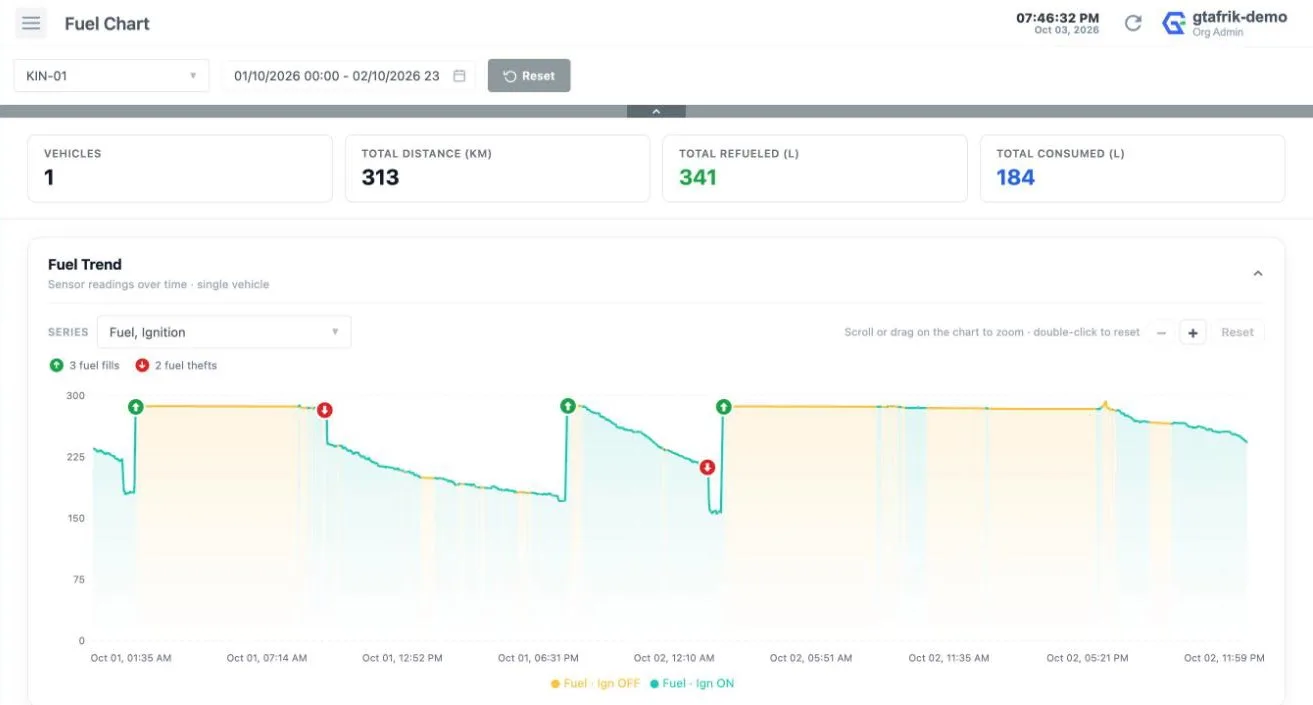
Capacitive fuel-level sensors (Escort, Omnicomm and the other sensors already integrated) measure the contents of the tank in litres. GT AFRIK cross-checks every change against GPS position and engine state, then flags suspicious drops — siphoning, ghost refuels, extended idling — on WhatsApp in about 60 seconds, with the location and volume, so a manager can review the event.
Read the field guide: fuel monitoring and investigationHow it works
01
The capacitive sensor reads real tank volume continuously — not the dashboard gauge.
02
Every change is cross-checked against GPS position, engine state and time. A station refuel ≠ a drop while parked.
03
Suspicious drop → WhatsApp alert to the manager with location, volume and vehicle. Early enough to act.
WHATSAPP ALERT IN ABOUT 60 SECONDS
The most common DRC fleet fraud patterns, encoded into detection rules.
Draining the tank while parked, usually at night or off-zone.
✓ Drop + engine off
A 200 L receipt, a tank that only gained 140. The difference is pocketed.
✓ Receipt vs measured volume
Engine running for hours while parked — AC, naps, or padded hour meters.
✓ Idle > threshold + litres burned
Padded routes to justify consumption — or resell along the way.
✓ Route deviation + burn rate
Hardware
Capacitive sensor fitted inside the tank, paired wirelessly over Bluetooth Low Energy. No drilled fuel lines, no float arms to snag — readings in litres.
± 1%
maximum measurement error of the Escort capacitive sensor, according to Escort — readings in litres, not vague fractions.
Capacitive fuel-level sensors measure the diesel in the tank in litres; we have already integrated Escort, Omnicomm and other sensors. Each change is cross-checked against GPS position and engine state, so siphoning, ghost refuels and suspicious drops trigger a WhatsApp alert with the location and volume in about 60 seconds.
Four schemes to watch for in DRC fleets: siphoning (draining the tank while parked, often at night or off-zone), ghost refuelling (for example, a 200 L receipt for a tank that only gained 140 L), extended idling (engines running for hours while parked) and fuel detours (padded routes to justify consumption or resell diesel along the way).
No. The factory gauge only gives an indication. A capacitive sensor such as the Escort TD-BLE has a measurement error of no more than 1% according to Escort, and every drop is time-stamped and located by GPS.
GT AFRIK’s technicians fit the sensor in one visit, and theft alerts reach WhatsApp the same afternoon.
Capacitive fuel-level sensors: the Escort TD-BLE, paired over Bluetooth Low Energy with a Teltonika FMB920 or FMB125, with a measurement error of no more than 1% according to Escort, or Omnicomm sensors. The supported devices page lists every option.
Sensor installed in one visit. Theft alerts on WhatsApp the same afternoon.
Request Demo