
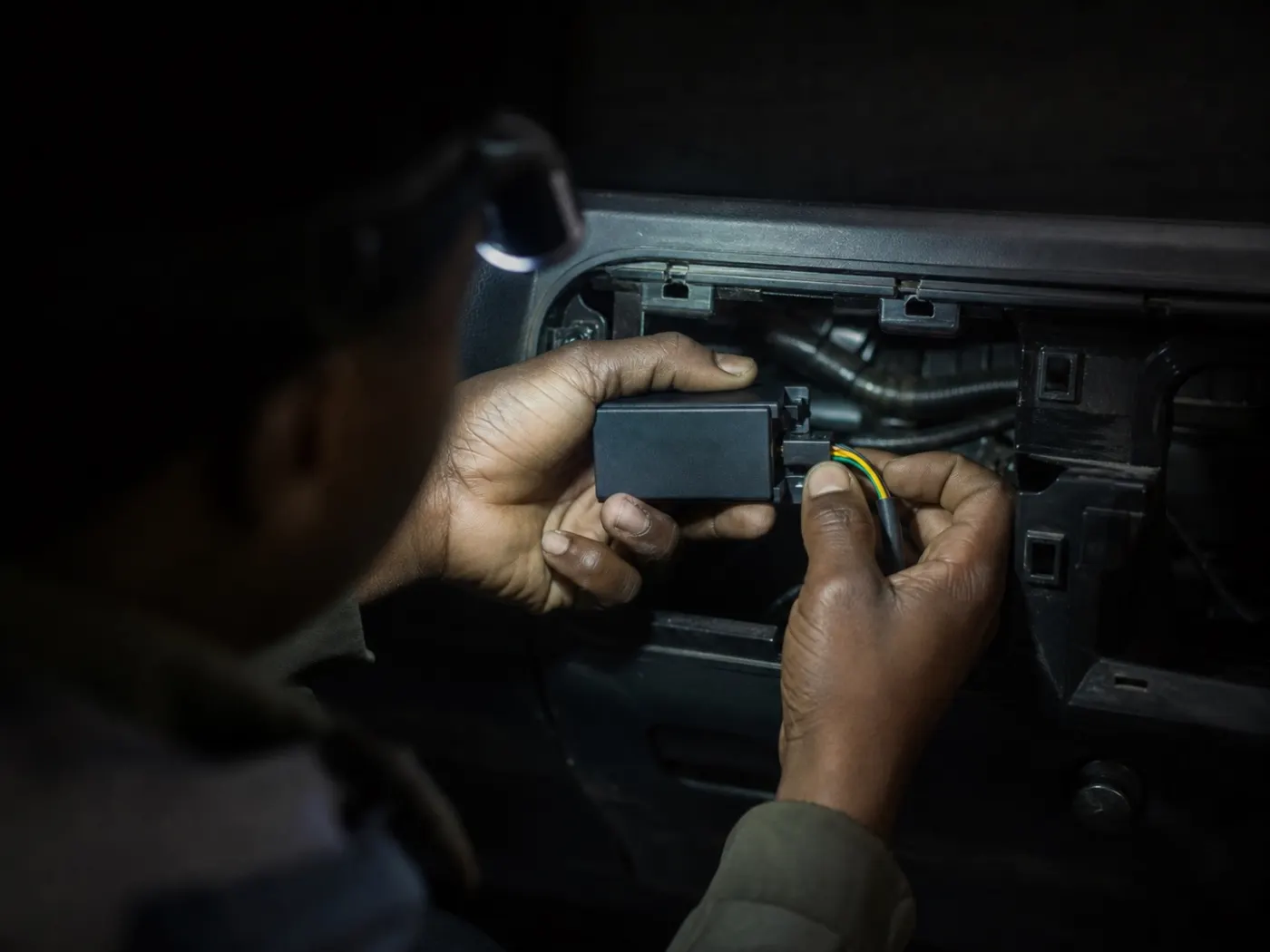
The GT AFRIK platform works with every Teltonika GPS tracker model, with capacitive fuel-level sensors including Escort and Omnicomm, and with DSE (Deep Sea Electronics), ComAp and DATAKOM generator controllers over Modbus RTU. The usual choices are the Teltonika FMB920 for vehicles and the FMB125 for generator controllers, which it reads over RS-485. GT AFRIK’s own technicians install the equipment, and systems are typically live within 48 hours.
Which Teltonika GPS trackers are supported?
Every Teltonika tracker model is integrated with the GT AFRIK platform. The tables below list current models by use, with the network type Teltonika states for each. GT AFRIK’s standard vehicle tracking runs on 2G GSM/GPRS, with GPS, GLONASS and Galileo positioning, a position every 30 seconds, route playback, geofencing and driver scoring.
Teltonika’s 4G versions (LTE Cat 1 or Cat M1) only make sense where your mobile operator’s LTE network covers your routes, so check coverage before you choose one.
Basic vehicle tracking
| Model | Network | Typical use |
|---|---|---|
| FMB920 | 2G | Compact tracker with a backup battery for cars, pickups and vans. GT AFRIK’s usual choice for vehicles. |
| FMC920 | 4G LTE Cat 1 | Same compact format and use, where LTE Cat 1 coverage is reliable. |
| FMM920 | 4G LTE Cat M1 | Same compact format, for operators that offer LTE-M (Cat M1). |
Advanced and CAN-bus vehicle tracking
| Model | Network | Typical use |
|---|---|---|
| FMB130 | 2G | More wired inputs and outputs. Teltonika positions it for machines with high fuel use, such as construction and farm equipment. |
| FMC130 | 4G LTE Cat 1 | LTE version of the FMB130, with the same flexible inputs. |
| FMB140 | 2G | Built-in CAN reader for engine data (CAN and CAN FD) from light and electric vehicles, buses and special machinery. |
| FMC150 | 4G LTE Cat 1 | LTE tracker with an integrated CAN data processor. |
Heavy vehicles, generators and serial sensors
| Model | Network | Typical use |
|---|---|---|
| FMB125 | 2G | RS-232 and RS-485 ports, dual SIM and RFID support. GT AFRIK’s usual choice for generator controllers over RS-485/Modbus. |
| FMC125 | 4G LTE Cat 1 | LTE version of the FMB125, with the same RS-232/RS-485 ports, dual SIM and RFID support. |
| FMC650 | 4G LTE Cat 1 | Terminal for demanding installations, with a high-capacity backup battery and external antennas. |
OBD plug-in tracking
| Model | Network | Typical use |
|---|---|---|
| FMB003 | 2G | Plugs into the vehicle’s OBD port and reads the manufacturer’s odometer and fuel-level data on supported cars. |
| FMC003 | 4G LTE Cat 1 | LTE OBD tracker with the same data reading. Teltonika publishes the list of supported vehicles. |
Battery-powered asset trackers
| Model | Network | Typical use |
|---|---|---|
| TAT100 | 2G | Needs no vehicle power. IP68 case and long battery life, for containers, goods and construction equipment. |
| TAT140 | 4G LTE Cat 1 | Battery-powered, with a magnetic holder, for containers, goods and machinery. |
| TAT240 | 4G LTE Cat 1 | Tamper-proof casing with magnetic mounting, for rental equipment and containers. |
Battery-powered trackers are normally set to report less often than wired trackers, to save battery.
Electric two-wheelers and e-mobility
| Model | Network | Typical use |
|---|---|---|
| TFT100 | 2G | Water-resistant tracker for high-voltage electric vehicles and special machinery, with CAN, RS-232 and RS-485. |
| FTC305 | 4G LTE Cat 1 | Compact e-mobility tracker with a 10–97 V supply range, CAN data reading and an IP67 casing. |
These tables only list models Teltonika shows as current on its website on 3 October 2026. Models on Teltonika’s end-of-life list are left out.
Which fuel-level sensors are supported?
Capacitive fuel-level sensors are already integrated, including Escort and Omnicomm. Readings are cross-checked against GPS position and engine state, and a suspicious drop sends a WhatsApp alert in about 60 seconds. The connection details below are as stated by each manufacturer.
| Sensor | Connection | Typical use |
|---|---|---|
| Escort TD-150 | Wired: RS-485, frequency or analog output | Cut-to-length probe for vehicle tanks, machinery, generators and fixed tanks. |
| Escort TD-150 BLE | Wired RS-485, frequency or analog, plus Bluetooth LE | Same wired use, with setup and calibration from a mobile app. |
| Escort TD-BLE | Wireless: Bluetooth LE, internal battery | Fitted inside the tank with no cable to the tracker. Pairs with the Teltonika FMB920 or FMB125, and is the sensor shown on GT AFRIK’s fuel monitoring page. |
| Omnicomm LLS 6 AI | RS-485, LLS or Modbus protocol | Omnicomm’s newest line. Filters fuel-level readings inside the sensor. |
| Omnicomm LLS 5 | RS-232 or RS-485, LLS or Modbus protocol | Adjusts to changes in fuel properties. For vehicles and fixed tanks. |
Confirm the exact sensor model with us before you buy. The fuel monitoring guide explains installation and tank calibration.
Which generator controllers can be monitored?
GT AFRIK reads generator controllers over Modbus RTU, through a Teltonika FMB125 connected over RS-485. The platform shows runtime hours, fuel level, battery voltage and alarms.
| Brand | Controllers | Connection |
|---|---|---|
| DSE (Deep Sea Electronics) | DSE controllers | Modbus RTU over RS-485, via FMB125 |
| ComAp | InteliLite, InteliGen | Modbus RTU over RS-485, via FMB125 |
| DATAKOM | D-500, D-700 | Modbus RTU over RS-485, via FMB125 |
Controller models differ in the Modbus registers they expose, so send us the exact controller model before installation. The generator monitoring guide explains what to check.
How does installation work?
- Tell us what you run. Vehicle types, tanks, generator controller models and the areas you operate in, through the contact page, at sales@gtafrik.com or on WhatsApp at +243 808 040 347.
- Choose the hardware. The FMB920 is the typical choice for vehicles and the FMB125 for generator controllers. The tables above cover other needs.
- Installation. GT AFRIK’s own technicians install the trackers and sensors. Systems are typically live within 48 hours.
- Day-to-day use. Dashboards, reports and support are available in French and English, and alerts arrive on WhatsApp. No long-term contract is required.
Frequently asked questions
Primary sources
Each model name in the tables above links to its manufacturer page.