
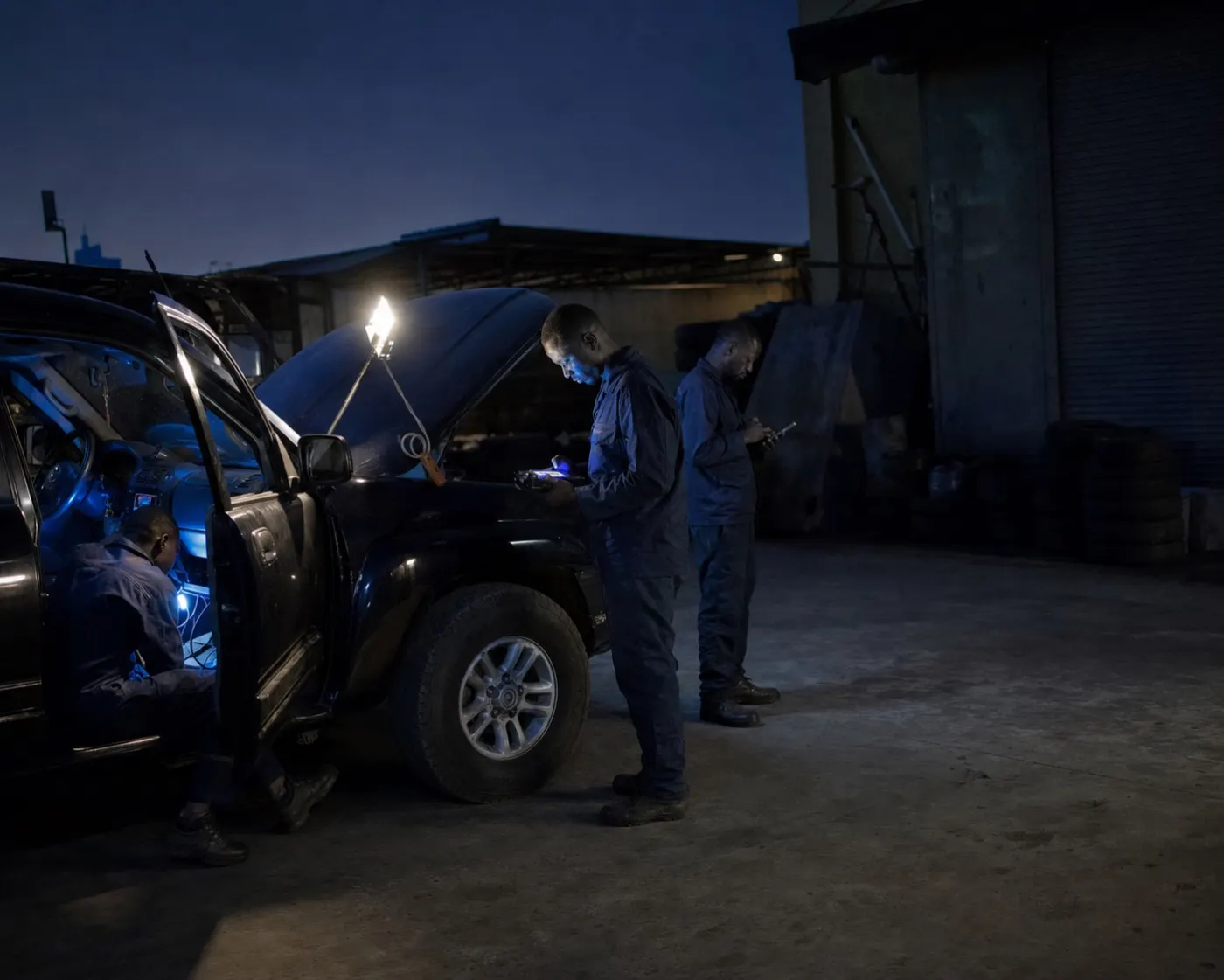
GT AFRIK provides GPS fleet tracking, fuel monitoring and generator monitoring in Kinshasa, where the company has its headquarters, at Avenue du Marché No 26. GT AFRIK’s own technicians install the trackers in Kinshasa, systems are typically live within 48 hours, and alerts arrive on WhatsApp with no extra app to install.
Why fleets in Kinshasa use GPS tracking
Running vehicles in Kinshasa means working with conditions every operator in the city knows. Each one maps to something the platform records.
- Slow traffic on the main roads. Congestion on roads such as Boulevard du 30 Juin, Boulevard Lumumba and the road to N’djili airport makes arrival times hard to predict. It also makes it hard to tell a driver stuck in traffic from a driver who made a detour. With a position every 30 seconds and route playback, a supervisor sees where a vehicle was and for how long, without relying on a phone call. Driver scoring adds a record of how each vehicle is driven.
- Vehicles spread across communes. One fleet can deliver in Gombe, load at a depot in Limete or the Kingabwa industrial area, and visit clients in Ngaliema, Kintambo or Masina on the same day. Geofences around depots, client sites and yards record each arrival and departure, so the daily picture comes from the map rather than from memory.
- Fuel siphoning. Diesel can be siphoned from a truck’s tank overnight or from a generator’s tank on site. A capacitive fuel-level sensor measures the tank, the reading is cross-checked against GPS position and engine state, and a suspicious drop sends a WhatsApp alert in about 60 seconds.
- Power cuts (délestages). When the grid goes down, generators keep offices, shops, cold rooms and technical sites running, sometimes for hours. Monitoring the generator controller shows runtime hours, fuel level, battery voltage and alarms, so you know how long each generator ran and how its fuel level moved.
- Trips out of the city. Vehicles that leave Kinshasa on the N1 toward Matadi and Kongo Central, or head eastwards, are hard to follow by phone. Geofences at the depot and at destination sites show when a vehicle left and arrived, and route playback shows the trip and its stops.
What you get in Kinshasa
| Item | Details |
|---|---|
| Local team | Headquarters at Avenue du Marché No 26, Kinshasa. Installation by GT AFRIK’s own technicians, not a subcontractor. |
| Installation | Hidden, hard-wired and tamper-alerted. Typically live within 48 hours. |
| Vehicle tracking | Teltonika trackers, usually the FMB920. 2G GSM/GPRS, GPS, GLONASS and Galileo positioning, a position every 30 seconds, route playback, geofencing and driver scoring. |
| Fuel monitoring | Capacitive fuel-level sensors: the Escort TD-BLE (±1% volume accuracy) or Omnicomm. Cross-checked against GPS position and engine state, with a WhatsApp alert in about 60 seconds for a suspicious drop. |
| Generator monitoring | DSE, ComAp and DATAKOM controllers, read over Modbus RTU through a Teltonika FMB125: runtime hours, fuel level, battery voltage and alarms. |
| Alerts | On WhatsApp, with no extra app required. |
| Languages | Dashboards, reports and support in French and English. |
| Contract | No long-term contract required. |
The product pages go into more detail: fleet tracking, fuel monitoring and generator monitoring.
How installation works in Kinshasa
- Contact GT AFRIK. Tell us how many vehicles, tanks and generators you run and which communes they are based in, through the contact page, at sales@gtafrik.com or on WhatsApp at +243 808 040 347.
- Choose the hardware. The Teltonika FMB920 is the typical tracker for vehicles and the FMB125 for generator controllers. The supported devices page lists every option, and the buyer’s checklist covers the questions to ask any provider.
- Installation by GT AFRIK technicians. Each tracker is hidden, hard-wired and tamper-alerted. The same team fits fuel sensors and connects generator controllers.
- Live, typically within 48 hours. Once the system is live, positions, fuel readings and generator data appear on your dashboard.
- Daily use in French or English. Dashboards, reports and support are available in both languages, and alerts arrive on WhatsApp. The daily fleet checklist shows what to review each morning.
Beyond Kinshasa
GT AFRIK also has local teams in Lubumbashi, in the DRC, and in Brazzaville, in the Republic of the Congo. A company that runs vehicles or sites in more than one of these cities works with the same platform, with installation by GT AFRIK’s own technicians in each. Goma, Mbuji-Mayi and Bukavu are planned for 2026. The about page describes the company, founded in 2019, and its teams.
Frequently asked questions
Sources
The service details on this page match these GT AFRIK pages.